What “premium butter” means for baklava
Premium baklava butter should taste clean, dairy-sweet, and aromatic—not oily, not waxy, not “barny,” and never stale. For export, the priority is stability: you want the same aroma on day 1 and day 30.
Key takeaways
- Sensory wins first: simple aroma/melt checks catch most failures before you scale volume.
- Consistency beats “one good batch”: require lot codes + repeatable checks for every shipment.
- Clarified butter helps—if done right: lower moisture/milk solids can improve stability, but low-quality input butter still fails.
- Storage is part of quality: heat, light, oxygen, and time accelerate oxidation and off-flavors.
On this page
Importer-friendly taste tests (5 minutes)
These quick checks work even if you’re not a dairy lab. Do them with the same method every time (same room temp, same sample size), and compare across batches.
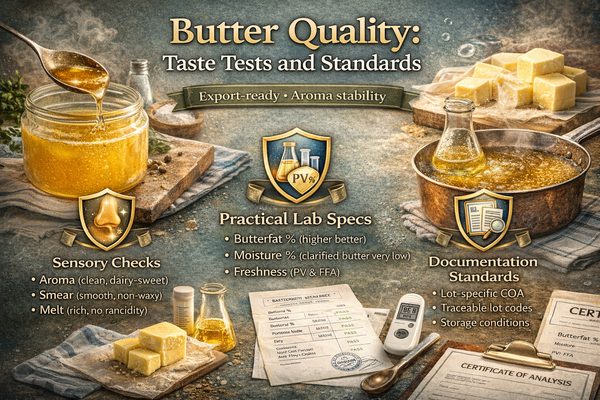
1) Aroma check (cold + room temperature)
- Smell directly from the pack when cold: should be mild and clean.
- Let a small piece sit at room temp 10 minutes: aroma should become richer, not sharper.
2) Smear test (texture + “waxiness”)
- Smear a thin layer on a spoon or plate: it should spread smoothly.
- Waxy, greasy, or sticky feel can signal poor fat profile, oxidation, or contamination.
3) Gentle warm-melt sniff (fast defect detector)
- Warm a small amount (don’t burn) until just melted.
- Good: sweet, creamy, nutty notes. Bad: sharp paint-like, cardboard, soapy, or barny notes.
If you’re using clarified butter (sade yağ), the warm-melt sniff is even more revealing because aromas are concentrated.
Off-flavor map: what defects taste like
Use this as a practical “translation” when you taste something wrong.
- Cardboard/papery: oxidation (often worsens with time/heat).
- Paint/varnish-like: advanced oxidation; reject for premium baklava.
- Soapy/bitter: lipolysis/rancidity; can show after storage.
- Barny/feed notes: raw material or handling issues; can dominate pistachio aroma.
- Burnt/milky-caramel: overheated butter or excess milk solids during processing.
Practical standards/specs to request
Specs vary by butter type and market regulations. If you don’t want to set hard numeric limits, request lot-specific COA plus “pass/fail” commitments for freshness and oxidation indicators.
Core specs worth asking for
- Butterfat % (for standard butter; higher/consistent supports aroma and bake performance).
- Moisture % (important for stability; clarified butter should be very low moisture).
- Oxidation freshness indicators (where available): peroxide value (PV) and/or free fatty acids (FFA).
- Milk solids / sediment (esp. for clarified butter—low solids reduces burning risk).
- Color + aroma consistency (sensory spec with reference samples).
Supplier documentation checklist
- Lot-specific COA (each shipment / batch).
- Ingredient & allergen statement (dairy; possible cross-contact).
- Production date + best before, plus lot/trace codes on cartons.
- Storage/handling requirements (temperature guidance, light protection).
- Origin + processing description (butter vs clarified butter; filtration method if relevant).
Handling & storage rules for export
Even good butter can degrade quickly if it’s exposed to heat, oxygen, or light. In baklava production, degradation shows up as muted aroma or “old oil” notes.
Best practices
- Keep it cool and stable: avoid temperature spikes and warm storage areas.
- Limit oxygen exposure: minimize open time; reseal properly; use smaller containers if needed.
- Protect from light: light accelerates oxidation and off-flavors.
- FIFO by lot code: rotate stock strictly; don’t blend unknown lots in premium production.
Want the butter-processing foundation? See: Clarified Butter (Sade Yağ): Why It Matters.
Copy-paste butter-quality RFQ
Use this to align expectations with suppliers and prevent “it tasted different this time” surprises.
RFQ template
- Butter type: standard butter / clarified butter (sade yağ)
- Use case: premium baklava export (aroma stability required)
- Batch control: lot codes on cartons + COA for every shipment
- Core specs requested: butterfat %, moisture %, oxidation freshness indicators (PV/FFA) where available
- Sensory requirement: clean dairy aroma, no rancid/cardboard/paint notes; consistent color and aroma across lots
- Handling: provide recommended storage temperature and shelf-life guidance
- Verification: supplier to approve a reference sample and match future lots to reference
FAQ
Is clarified butter (sade yağ) the same as ghee?
They’re similar in that both remove most water and milk solids, but flavor and processing details can differ by producer. For baklava, what matters is clean aroma, low moisture, and consistent results in baking.
Why does butter taste fine at first but goes “flat” later?
Oxidation can be subtle early and more obvious later, especially after warm storage. That’s why lot control, COA, and consistent storage are non-negotiable for export programs.
What’s the simplest butter quality system for importers?
Approve a reference sample, run the same 3 sensory checks on every lot, and require lot-specific documentation. This catches most issues before they reach your customers.