Allergen labeling that survives export reality
For baklava, the core allergens are usually tree nuts, wheat/gluten, and milk. Your goal is to (1) declare what’s intentionally used and (2) handle cross-contact risk honestly and consistently.
Key takeaways
- Write ingredients first, then allergens: allergens should be supported by the ingredient list and supplier statements.
- Be specific with nuts: “pistachio” and/or “walnut” is better than generic “nuts” when possible.
- Use cross-contact wording only when needed: “may contain” should match real facility risk and your supplier’s assessment.
- Traceability is non-negotiable: batch/lot codes + production date/best-before + manufacturer/exporter details.
- Private label requires change control: any recipe or supplier change can trigger label updates.
On this page
1) What you must declare for baklava
Most baklava formulations include:
- Tree nuts: pistachio and/or walnut are common (sometimes hazelnut, almond, cashew in assortments).
- Wheat / gluten: phyllo (yufka/phyllo dough is wheat-based).
- Milk: butter or clarified butter (ghee/sade yağ).
Some varieties may also include egg (recipe-dependent) or cross-contact with sesame / peanut in mixed facilities.
2) Ingredient list best practices
Ingredient lists are easiest to manage when you standardize the format:
- Use simple common names: “wheat flour”, “butter”, “pistachio”.
- Order by predominance: highest to lowest by weight at time of manufacture (standard practice in many markets).
- Be consistent across SKUs: assortments should list all possible ingredients or clearly separate by variety (depending on your packaging and market rules).
- Avoid marketing terms inside ingredients: keep “premium”, “Gaziantep”, etc. for front-of-pack, not the ingredients panel.
Example ingredient list (generic)
Ingredients: Wheat flour (gluten), pistachio, sugar, butter (milk), water, starch, salt.
Note: real formulas vary—always align with the supplier’s confirmed recipe/spec sheet.
3) Allergen statement + cross-contact wording
Your allergen statement should do two jobs:
- Declare intentional allergens present in the recipe.
- Address cross-contact only when the facility risk warrants it.
Allergen statement examples
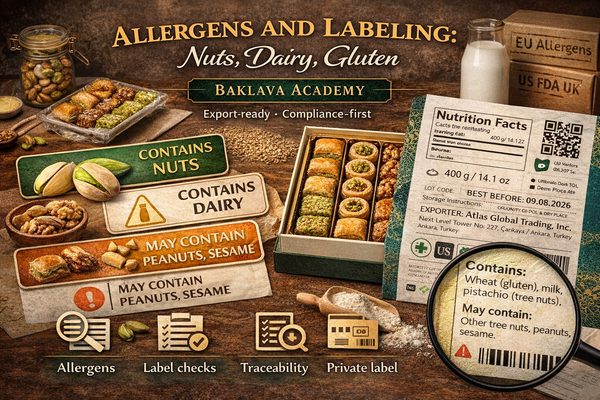
- Contains: Wheat (gluten), milk, pistachio (tree nuts).
- May contain: Other tree nuts, peanuts, sesame. (Use only if supported by facility risk.)
Tip: Keep “may contain” specific (list likely allergens), not vague (“may contain traces of allergens”).
4) Label fields that prevent rejections
Even when the ingredients are correct, shipments fail over missing basics. Ensure your label includes:
- Product name + variant (e.g., Pistachio Baklava).
- Net weight (units appropriate for the destination).
- Ingredients + allergen statement.
- Best-before / expiry and (often) production date.
- Lot / batch code (traceability).
- Storage instructions (temperature + “keep sealed” guidance).
- Manufacturer / exporter details + country of origin.
- Nutrition panel in the destination format (when required).
- Barcode (if required by your retailer/channel).
5) Supplier docs to request (COA + allergen pack)
For importers and private label, request a simple documentation pack per SKU/lot:
- Ingredient specification (including allergen declarations).
- Allergen matrix (what’s present vs possible cross-contact).
- Batch/lot info (production date + batch code mapping).
- COA / quality statement where available (especially for nuts/butter inputs or finished product).
- Label artwork approval (final PDF/AI) with version control.
6) Batch checks for importers (quick QC)
When a shipment arrives, do a 10-minute check before it hits distribution:
- Confirm net weight and piece count vs spec.
- Verify lot/batch code + best-before are printed and legible.
- Check the seal (no leaks, no loose corners).
- Inspect for oil migration or moisture condensation inside packaging.
- Validate allergen statement matches the agreed recipe (especially when assortments change).
Copy-paste templates
Template: importer label checklist (send to supplier)
- Product name + variant: ________
- Ingredients list (final): ________
- Allergen statement (final): ________
- Cross-contact statement (if needed): ________
- Net weight: ________
- Best-before + production date: ________
- Lot/batch coding format: ________
- Storage instructions: ________
- Manufacturer/exporter + origin: ________
- Nutrition format required? Yes/No (details): ________
- Barcode required? Yes/No (type): ________
- Languages required: ________
Template: allergen statement
Contains: Wheat (gluten), milk, pistachio (tree nuts).
May contain: Other tree nuts, peanuts, sesame. (Only if applicable.)
Related: Private Label Baklava • Assortment Box
FAQ
Is “may contain” mandatory?
Not always. It’s a risk communication tool. Use it when shared equipment/rooms or ingredient handling creates a real cross-contact risk, and your supplier cannot guarantee validated segregation and cleaning for that allergen.
Can I label a product “gluten-free” or “dairy-free”?
For traditional baklava, that’s rarely appropriate because phyllo is wheat-based and butter is common. Only make “free-from” claims if the recipe and facility controls truly support it and your destination market rules are met.
What changes should trigger a label review?
Any change in nut type, butter source, dough formulation, emulsifiers/additives, or facility allergen handling should trigger a review— even if the product “looks the same.”